
Insights · Buyer guide
How to compare builder quotes, a Brisbane checklist
How to compare builder quotes is the single most useful skill you can develop before signing a new home contract. Two quotes that look similar at the front page can differ by $80,000 by the time you reach handover. This guide is the line-by-line checklist the team at Oakridge Living uses when we sit with clients to compare their other quote against ours.
Step 1: Match the scope before you compare the price
Almost every first conversation we have starts with a homeowner holding two quotes that don't compare like-for-like. The headline price is often the least useful number on the page.
Use this checklist as a printable framework. If you'd rather, bring both quotes to us and we'll walk through them with you.
Before comparing dollar figures, confirm both quotes describe the same scope.
If the scope is different, you're not comparing builders, you're comparing different homes. Adjust the scope first, then compare.
Same designfloor plan, total floor area in square metres, number of bedrooms and bathrooms
Same ceiling height2.4m, 2.55m or 2.7m
Same external footprintalfresco size, garage size, porch size
Same number of storeysa single-storey vs double-storey comparison is not a comparison
Same block conditionsM or H class soil, flat or sloping, with or without overlays
Step 2: Compare the standard inclusions line by line
Print both inclusion documents and sit them side by side. For every line item in one, find the matching line item in the other.
If one quote excludes an item the other includes, that's the gap. Multiply each gap by the realistic retail cost of adding it later.
What's included
Kitchen
Bench top material (laminate, stone, engineered stone, type and thickness)
Cabinetry construction (melamine, polyurethane, two-pack)
Soft-close drawers and doors (standard or upgrade)
Appliance package (brand, model numbers, induction or gas, range hood type)
Sink (single bowl, double bowl, undermount or top-mount)
Tapware brand
What's included
Bathroom and ensuite
Tile allowance (per square metre, brand)
Tapware brand
Shower screen (semi-frameless, frameless, height)
Vanity (size, top material, basin type)
Toilet (brand, two-piece or one-piece, soft-close seat)
Mirror size and style
Heated towel rail (included or excluded)
What's included
Floor coverings
Carpet (brand, weight, underlay)
Tile or timber-look (brand, format, where used)
Allowance per square metre
What's included
External
Brick (range, supplier)
Roof tile or Colorbond (type, profile)
Windows (aluminium, timber-look, double glazing if specified)
Front door specification
Garage door (panel lift, sectional)
Driveway concrete (included, allowance, plain or exposed aggregate)
What's included
Electrical
Number of GPOs
Number of light points
LED downlights vs basic ceiling lights
Data and TV points
Smoke alarms to current standards (interconnected, mains powered)
NBN rough-in
What's included
Air conditioning and insulation
Number of split systems
Ducted (size, brand)
Insulation R-values for ceiling and walls
Step 3: Read the provisional sums and prime cost items carefully
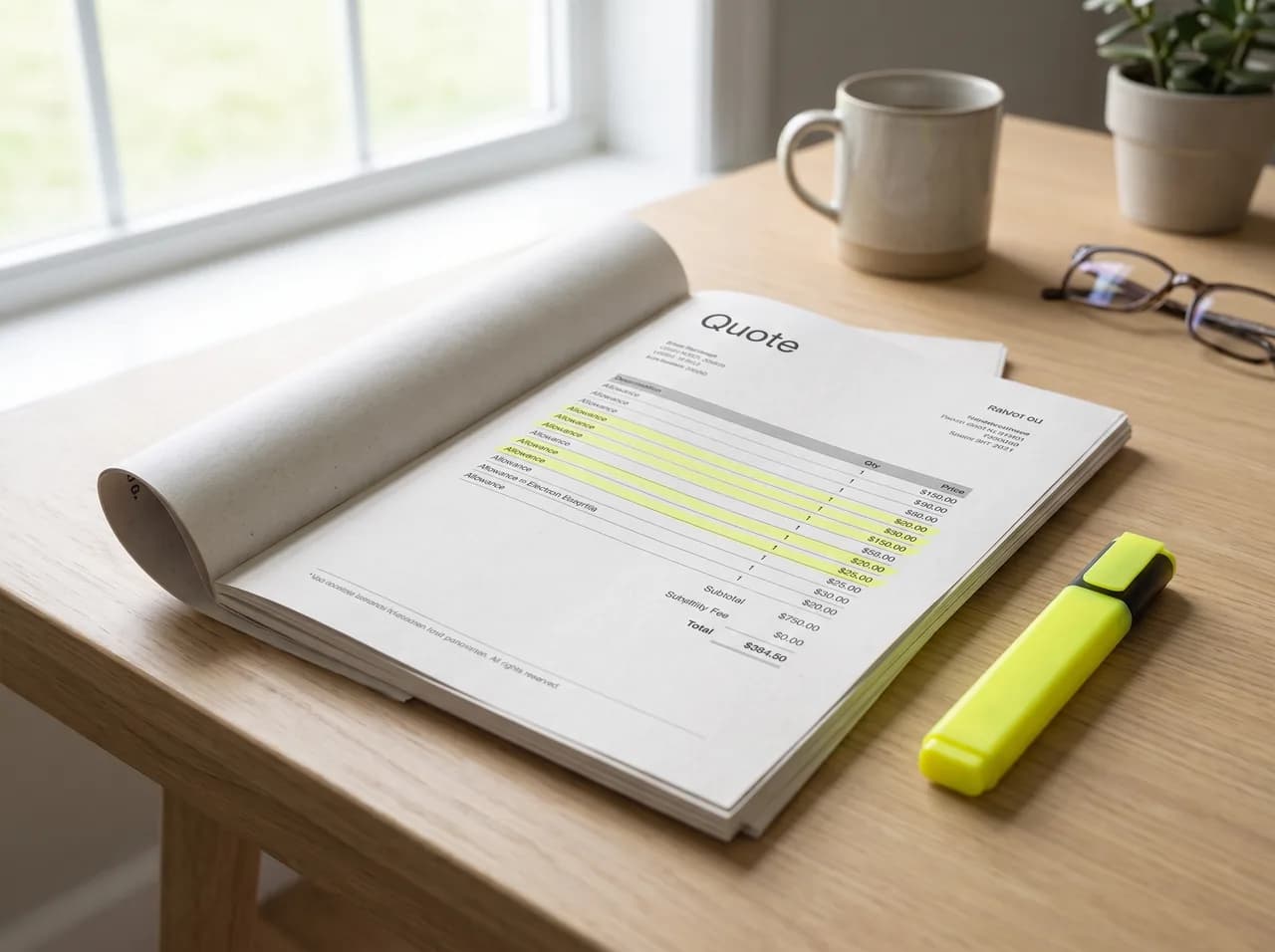
A “provisional sum” is an allowance for an item the builder can't price exactly at signing. A “prime cost item” is an allowance for a specific item (an appliance, a tap) you'll select later. Both can move: if the actual cost is higher, you pay the difference plus a margin and admin fee.
A quote heavy with provisional sums isn't a quote, it's a starting point.
What's included
For every provisional sum, ask
Why it's provisional (legitimate reasons exist, like rock excavation)
What the allowance is based on (a soil test? A guess?)
What the cap is, if any
Whether the builder will share the actual quotes when they come in
Step 4: Fixed-price vs cost-plus contracts
Fixed-price contracts are the standard for residential builds in Queensland and the contract type we use at Oakridge Living. The builder commits to a total price, with variations only where the contract genuinely allows them.
Cost-plus contracts charge you the actual cost of materials and labour, plus a margin. They're sometimes used for highly complex custom builds or restoration work. They're not common for standard new homes, and they carry budget risk you may not want to take on. If a builder is quoting cost-plus on a standard new home, ask why. The answer should be specific to your block, not a general preference.
Step 5: Builder quote red flags in Brisbane
Patterns we see that should slow you down before signing are listed below.
Any one of these on its own isn't a deal-breaker, but two or more in the same quote is a sign to ask harder questions.
“Starting from” prices that don't include site costs
A site cost provisional sum of $10k to $15k on a sloping or rural block (very unlikely to be real)
A quote without a soil test or contour survey
A quote that doesn't list the builder's licence number on the front page
A builder unwilling to share their full standard inclusions list before contract
Deposit requirements above 5% before contract signing (the residential contract deposit limit in QLD is 5% before construction starts)
Pressure to sign within 7 days “before the price goes up”
A contract that lists the trading name but not the legal entity
A quote without a clear list of exclusions
Step 6: Verify the licence before you sign
Take the builder's licence number off the front of every quote and verify it on the QBCC website.
Our licence detail is in the site footer if you want to check it the same way.
What's included
Check that
The licence is current, not suspended
The licence class covers the scope of the build
The licensee name matches the entity on the contract
Step 7: The contract review
Before you sign, get the contract reviewed. A construction lawyer or your conveyancer can read it for $300 to $700, which is the lowest-cost insurance you'll buy on a half-million-dollar build.
What's included
Specifically ask them to check
Variation clauses (how variations are priced and approved)
Termination clauses (your rights if the build stalls)
Practical completion definition
Defects liability period
Liquidated damages (penalty for late completion)
Progress payment schedule
Start the conversation
Ready to talk?
Whether you're ready to build or just exploring your options, we're here to help.